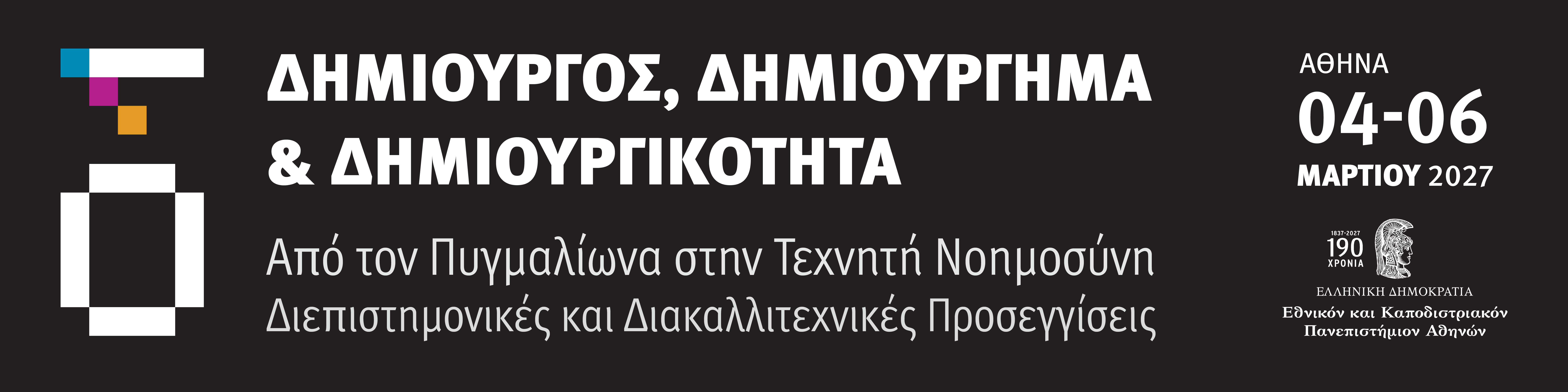
Creator, Creation, and Creativity: From Pygmalion to Artificial Intelligence
Interdisciplinary and Interartistic Approaches
Athens
4–6 March 2027
From cosmogonic myths to the Judeo-Christian tradition, the creation of life from inorganic matter appears to be an exclusively divine prerogative. Narratives about human creations that come to life invite us to reflect on the relationship between creator, creation, and created being. Ovid’s account of the myth of Pygmalion in the Metamorphoses, for example, raises fundamental questions concerning the act of creation and the context in which it takes place. The sculptor creates a statue of a woman so perfect that she appears to be alive, and he falls in love with her. The goddess Aphrodite is moved by his devotion and grants the statue life. However, Galatea, who initially exists only through Pygmalion’s desire and artistic creation, subsequently becomes an autonomous entity.
This narrative, which concerns the boundaries between nature and art/technology, human beings and their creations, and life and its simulation, reappears in various forms throughout the Western cultural tradition. From the anthropomorphic machines of antiquity and the Golems to the automata of the Renaissance and the Enlightenment, and from the conception of the human body as a machine to cyborgs and contemporary neural networks, perceptions of creation and the relationship between human beings and their creations have changed over time. They have been discussed in diverse ways within artistic and scientific communities as well as in the public sphere. However, representations and ideologies concerning this ultimately bidirectional relationship are never neutral: they are connected to, and simultaneously shape, positive or negative expectations and beliefs, influencing social practices and the institutional and political discourse of each historical period.
Today, the rapid development of Generative Artificial Intelligence (Generative AI) produces digital artefacts—including text, images, and code—in response to explicit user instructions. The same applies to Agentic AI, which further expands the range of artificial intelligence capabilities, as it is not limited to content generation but also performs processes resembling reasoning, planning, and autonomous action—and potentially forms of creativity. Both developments urgently bring the relationship between creator, creation, and creativity back to the forefront of scientific, philosophical, and social debate.
From Pygmalion, who falls in love with his own creation, to the contemporary user who anthropomorphises artificial intelligence, attributing intelligence and perhaps even emotions to it, the relationship between creator and creation remains a field in which desire, technology, and ethics converge in what we recognise as life, action, or subjectivity.
Researchers and early-career scholars—including doctoral candidates, PhD holders, and postdoctoral researchers—from literary studies, philosophy, theology, sociology, the arts, computer science, linguistics, law, medicine, psychology, digital sciences, and media studies are invited to critically explore the following topics, among others, from either a synchronic or a diachronic perspective:
- Aspects of the relationship between creator and creation, the systems of values that define or determine it, and its social and political impact.
- Representations, manifestations, genealogies, and ontologies of “artificial beings”.
- Questions of intentionality and autonomous action.
- Artistic and scientific debates concerning creation and intellectual property, as well as originality, aesthetic value, and mechanical (re)production, particularly in view of the data used to train artificial intelligence systems.
- The presence of artificial intelligence in the arts, including music, theatre, performance art, and other artistic practices, raises significant questions concerning the status of the artist, liveness, and the role of the audience, within the broader context of social and political changes associated with digital technologies.
- The ethical boundaries of the relationship between the creator and their creation.
- Reflection on the boundaries of the human and on subjectivity in an emerging posthuman era, as well as on the transformation of the natural, social, and human sciences. These questions become particularly relevant as the boundaries between nature and culture, human beings and machines, society and technology grow increasingly indistinct, while critical posthumanism calls for further questioning of biological and essentialist conceptions of humanity and nature.
The conference aims to initiate interdisciplinary dialogue by focusing on a series of open questions at the intersection of academic disciplines, artistic practices, and public discourse.
The abstract should identify the relevant thematic strand(s) and be accompanied by a short biography (up to 200 words). Proposals that do not fall within the thematic strands listed below may also be submitted, provided that their relevance to the overall conference theme is clearly demonstrate. The Scientific Committee’s decisions on submitted proposals will be announced on 10 December 2026.
The conference language is Greek.